Anna Markovics, Head of Fundraising, JCC Budapest
The presentation will introduce the documentary photography project Between Thin Lines by Helena Mede, a Human Rights student at CEU Exhibited at Queer Propaganda and Unseen Perspectives in Vienna. It captures the stories of four individuals Roman Samotný, Radka Trokšiarová, Tereza Zubáňová, and Jana Mičeková, one year after the 2022 terrorist attack at queer bar “Tepláreň” in Bratislava, each reflecting experiences shaped by the attack.
In the context of 2026, the presentation aims to highlight ongoing challenges and community efforts, further shedding light on the thin line between hateful speech and physical violence.
Together with Tereza Zubáňová, an activist and social work student at Comenius University in Bratislava, we will discuss community and resilience, situating these within the broader context of student initiatives and activism in Slovakia’s socio-political climate marked by anti-LGBTQ+ rhetoric
Presented by: Helena Mede and Tereza Zubáňová
During the workshop, participants will use various craft techniques to decorate prints related to minorities, reflecting on their own experiences and feelings. The creative process is accompanied by a facilitated discussion in a safe environment, focusing on the situation, visibility and everyday challenges of intersectional minorities in Hungary – such as Roma, LGBTQ+, ethnic, gender and religious minorities.
The aim of the workshop is to bring people from different backgrounds closer together through creation and to provide space for a sensitive yet liberating dialogue.
Presented by: Lili Komjáthy, program organizer, JCC Budapest – Bálint Ház
The UCCU Foundation’s workshop is an engaging and interactive session where young Roma participants have the opportunity to speak openly about the diversity of Roma communities, their own identities, and how prejudice against Roma people appears in everyday life.
During the workshop, participants also reflect together on how these prejudices are formed and explore tools and strategies to question and challenge them.
The sessions are led by trainers of Roma background. This creates a space for young Roma participants to actively engage in meaningful dialogue, helping them gain a deeper understanding of their culture and strengthen their self-confidence, while collectively seeking answers to broader social challenges.
*The tour is only available in Hungarian
Discover the locations in Budapest connected to the history of LGBTQI people, Roma, and Jewish communities! Where did those seeking same-sex partners meet at the turn of the 19th and 20th centuries, between the two World Wars, or before the regime change? Where were the first official LGBTQI venues located? Which buildings are linked to the history of Budapest’s Jewish community? What historic movement-related events took place in certain public spaces of the capital? Which famous LGBTQI, Jewish, or Roma figures are tied to Budapest? You can find the answers to these questions on a guided city walk led by Péter Hanzli (Program Manager, Háttér Archive and Library).
Presented by: Péter Hanzli, program director, Háttér Archive and library
In the context of minority rights protection, this presentation explores the MINOTEE – Minority Rights for Effective Enforcement project with Zsolt Körtvélyesi (researcher, ELTE Budapest) and Helena Mede (Human Rights student, CEU).
In light of growing challenges to minority rights in Europe, it examines the potential of collective redress mechanisms, drawing on early cases of minority reparation (e.g. Holocaust cases) and considering their application to Roma and Hungarian minorities in Slovakia, Hungary, and Romania. It also addresses minority rights activism, as well as current initiatives and developments.
The presentation further introduces the MINOTEE database a user-friendly collection of minority case law from Slovakia and Hungary, with summaries, English translations, and links to related cases, making national case law accessible to an international audience, alongside its social media presence.
Presented by: Helena Mede and Zsolt Körtvélyesi
How can we design training sessions that are mindful of the diverse identities, experiences, and power dynamics present in any learning space?
In this interactive workshop, participants will explore how an intersectional perspective can shape the way we plan and facilitate training.
Through short exercises and reflection, we will look at practical ways to create more inclusive and responsive learning environments.
The session invites trainers and facilitators to reflect on their own role in shaping safe and engaging spaces for learning.
This interactive session invites participants to reflect on the intersectional experiences they encounter in their own lives, or that they observe in their daily realities. By exploring dynamic fields of identities and social practices, participants will engage with the complexities of intersectionality through the hands-on creation of a practical, real-time intersectional map.
The session draws on collaborative practices and safe-space dialogue, aiming to address systemic inequalities in our societies. In this way, the session contributes to identifying key challenges of intersectional experiences, and invokes constructive strategies for engaging with intersectionality in both personal and professional contexts.
Presented by: Sonja Vilicic and Dragana Stojanovic
Intergroup solidarity among minority groups is crucial for driving social change, but these collaborations are rarely without friction. This interactive session explores the social psychology behind authentic allyship and cross-movement solidarity. Together, we will discuss how to build inclusive alliances that do not erase subgroup nuances, and examine practical strategies to strengthen our organizational practices.
The volume brings together original studies on the persistence of discrimination against Jewish, Roma, LGBTQ+, and disabled communities across Europe, tracing how historical exclusions continue to shape present-day policy, media, and public life. Drawing on discourse analysis, historical comparison, and fieldwork, contributors examine topics ranging from antisemitic language in Hungarian and German media to reproductive governance, Roma representation in education, and state-sponsored anti-queer rhetoric.
Presented by: Gabi Gőbl – Science for Society Hub Coordinator – Central European University
For 10 years now, every Monday at JCC Budapest – Bálint Ház, a free hora dance house awaits our young people with intellectual disabilities. Some master the steps brilliantly, but the essence is the liberation and joy that dance provides. Before the dance, there are creative craft sessions, mostly making gifts – now you too have the chance to join one such occasion and experience the All Hearts vibe!
Make little crafts with the All Hearts team! During the session, you’ll have the opportunity to get to know the members, create together, chat, and discover how shared crafting can bridge connections between you.
Step behind the scenes of Budapest Pride 2025 and discover how one of the largest Pride marches in Europe was organized under intense political pressure. In this interactive workshop, we will share how our team responded to public attacks, legal uncertainty, and logistical challenges while still mobilizing hundreds of thousands of people in only a few months.
Participants will gain insight into the strategies, risks, and collective effort behind last year’s march, from crisis management and communication to community organizing and international solidarity. This session offers an honest look at what it takes to deliver a Pride event when the political environment is openly hostile.
In Hungarian with English translations
Discover the locations in Budapest connected to the history of LGBTQI people, Roma, and Jewish communities! Where did those seeking same-sex partners meet at the turn of the 19th and 20th centuries, between the two World Wars, or before the regime change? Where were the first official LGBTQI venues located? Which buildings are linked to the history of Budapest’s Jewish community? What historic movement-related events took place in certain public spaces of the capital? Which famous LGBTQI, Jewish, or Roma figures are tied to Budapest? You can find the answers to these questions on a guided city walk led by Péter Hanzli (Program Manager, Háttér Archive and Library).
Presented by: Péter Hanzli, program director, Háttér Archive and library
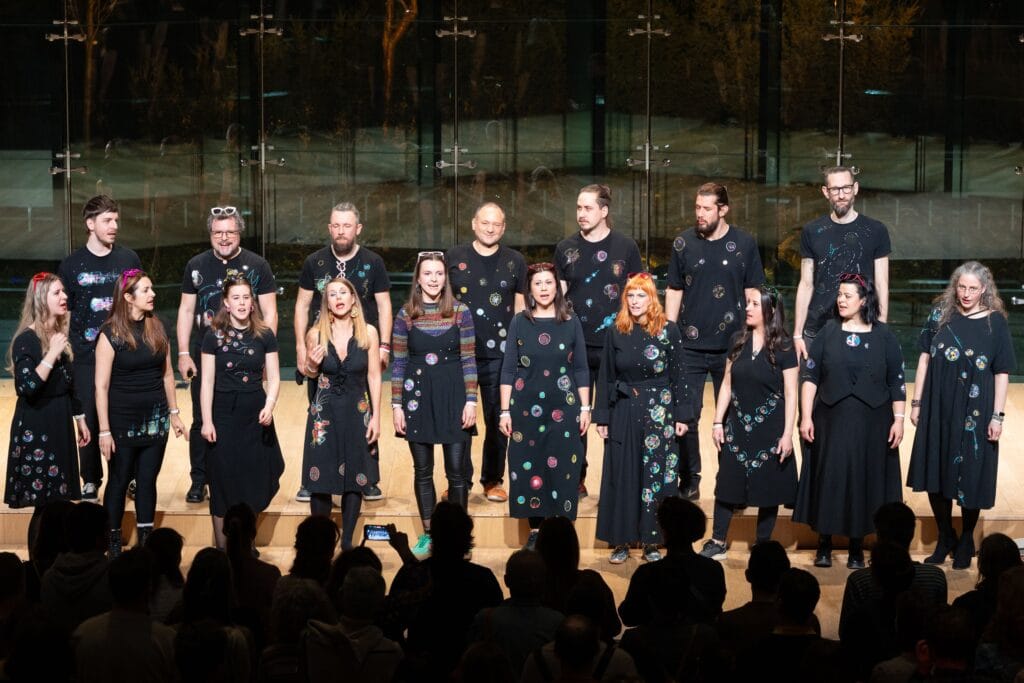
The Cheeky Choir presents songs from different nations with their own unique flavor. Their repertoire mainly consists of world music pieces – in addition to Hungarian folk adaptations, they draw inspiration from the neighboring Balkan, Romanian, Serbian, and Macedonian traditions, as well as from the more distant Finnish, Sephardic, Greek, African, Brazilian, and Haitian cultures.
Marcell Kenesei, Director of JCC Budapest – Bálint Ház